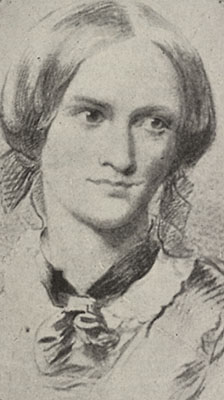
Charlotte Brontë, by George Richmond
Charlotte Brontë (1816-1855)
A selective list of online literary criticism and analysis for the English Victorian novelist Charlotte Brontë, favoring signed articles by recognized scholars and articles published in peer-reviewed sources
Main Page | 19th-Century Literary Criticism | 19th-Century Novelists | English Victorian Novelists | 19th-Century Women
Introduction & Biography
"Charlotte Brontë." The Victorian Web, ed. George Landow. Essays on Charlotte Brontë's writing techniques, themes, biography, and the Victorian cultural and historical context.
Giles, Judy. "Charlotte Brontë." A substantial introduction to Charlotte Brontë from the Literary Encyclopedia. On Jane Eyre; On Shirley; On Villette [subscription service].
Haworth, Home of the Brontës, short article for the tourist, by Judith Fein.
The Brontes. Quite old criticism, and annoying ads, The Cambridge History of English and American Literature (1907-21).
Literary Criticism
Farrell, John P. "A Message For Miss Eyre; or, Jane in Wonderland." Cahiers Victoriens et Edouardiens: Revue du Centre d'Etudes et de Recherches Victoriennes et Edouardiennes de Université Paul-Valéry, 8 (1979).
Hanley, Kirstin. "'A New Servitude: Pedagogy and Feminist Practice in Brontës Jane Eyre." On the portrayal of the woman teacher in nineteenth century fiction. Nineteenth-Century Gender Studies 5 (Winter 2009).
Hoeveler, Diane Long. "Smoke and Mirrors: Internalizing the Magic Lantern Show in Villette." Gothic Technologies, special Romantic Circles edition, Dec. 2005.
Kreilkamp, Ivan. Unuttered: Withheld speech and female authorship in Jane Eyre and Villette. Novel: A Forum on Fiction, Summer 1999 [first page only, jstor].
Murdoch, H. Adlai. "Ghosts in the mirror: Colonialism and Creole indeterminacy in Brontë and Sand, on the notion of the Creole in George Sand's Indiana and Jane Eyre." College Literature Winter 2002 [first page only, jstor].
Nandrea, Lorri G. "Desiring Difference: Sympathy and Sensibility in Jane Eyre." Novel: A Forum on Fiction, Fall 2003 [first page only, jstor].
Poovey, Mary. "The Anathematized Race: The Governess and Jane Eyre." In Uneven Developments: The Ideological Work of Gender in Mid-Victorian England (1988) [subscription service, enotes].
Shuttleworth, Sally. Charlotte Brontë and Victorian Psychology (Cambridge UP). Introduction.
Starzyk, Lawrence J. "'The gallery of memory': The pictoral in Jane Eyre." Papers on Language and Literature, Summer 1997 [sub ser, questia].
Vanskike, Elliott. Consistent Inconsistencies: The Transvestite Actress Madame Vestris and Charlotte Brontë's Shirley." Nineteenth Century Literature 50, 4 (March 1996) [first page only, jstor].
Postcolonial Jane Eyre
Kendrick, Robert. "Edward Rochester and the margins of masculinity in Jane Eyre and Wide Sargasso Sea." Papers on Language and Literature, Summer 1994 [sub ser, questia].
Simmons, Diane. "Jamaica Kincaid and the Canon: Dialogue With Paradise Lost and Jane Eyre." MELUS 23, 2 (Summer 1998) [first page only, jstor].
"The Imperial Archive." Web site examines Charlotte Brontë's Jane Eyre, and Jean Rhys's "rewriting" of Jane Eyre in Wide Sargasso Sea as a form of resistance to the colonial project. A project of graduate students at Queen's University, Belfast.
Bibliography & Web Sites
"The Victorian Governess: A Bibliography." A list of recommended books and articles on the governess in Victorian society and Victorian novels. Ed. Cynthia E Huggins, at the Victorian Web.
Nineteenth-Century Gender Studies. An open access, peer-reviewed journal publishing scholarship on gender studies and nineteenth-century British literature, art and culture.
The Brontës: Texts, Sources, and Criticism, includes 14 early (1840s) reviews of the Brontës. By Peter Friesen, SUNY Plattsburgh.
"Women in the Literary Marketplace," an online exhibit from the Division of Rare and Manuscript Collections at Cornell U, contains short entries on several Victorian women authors and their typical themes, information about the publishing context, and some images of first editions.
Main Page | 19th-Century Literary Criticism | 19th-Century Novelists | English Victorian Novelists | 19th-Century Women
1998-2012 by LiteraryHistory.com