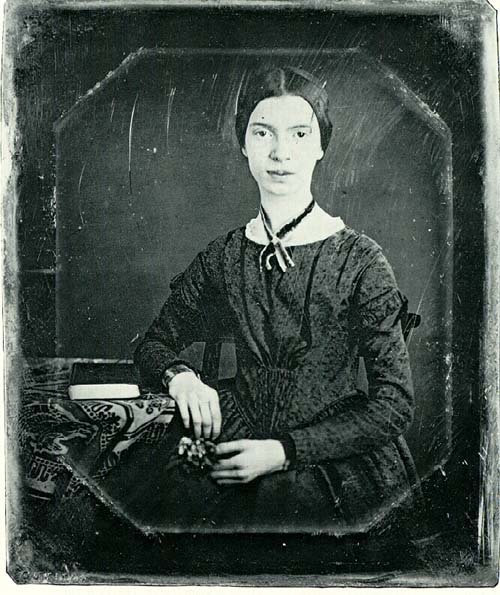
Public domain photograph of Emily Dickinson
Emily Dickinson (1830-1886)
A selective list of online literary criticism for the nineteenth-century American poet Emily Dickinson, with links to reliable biographical and introductory material and signed, peer-reviewed literary criticism
Main Page | 19th-C American Writers | 19th-C Poets | About LiteraryHistory.com
Introduction & Biography
"Emily Dickinson," ed. Karen Ford. Excerpts of literary criticism from scholarly authorities on Dickinson. Includes a biography of Emily Dickinson and individual discussion of the many of her most famous poems. Modern American Poetry at Univ. of Illinois.
"Emily Dickinson." An encyclopedia-type article on Emily Dickinson. Also a selection of her most famous poems, recommended reading, and additional articles about her. The Poetry Foundation.
"Emily Dickinson." Introduction to Dickinson by professors Peggy McIntosh and Ellen Louise Hart, in the college textbook Heath Anthology of American Literature.
"Emily Dickinson." A short biographical introduction to Dickinson, with text for some of her best known poems. Additional articles on Dickinson: "Isaac Watts & Emily Dickinson: Inherited Meter." Also, a poet writing on the poet, Michael Ryan on Emily Dickinson. Academy of American Poets.
"Helen Vendler's Emily Dickinson." Podcast with Harvard Prof. Helen Vendler, interviewed by Christopher Lydon, discussing Dickinson's "bald and chilling" poems. Radio Open Source 5 Oct. 2010.
"Emily Dickinson's Letters." Article from the 1891 Atlantic Monthly magazine, written by her friend and "discoverer," Thomas Wentworth Higginson. "Few events in American literary history have been more curious than the sudden rise of Emily Dickinson into a posthumous fame only more accentuated by the utterly recluse character of her life and by her aversion to even a literary publicity."
Oates, Joyce Carol. "Joyce Carol Oates on Emily Dickinson." Two essays on Emily Dickinson's poetry by the famous novelist Joyce Carol Oates. Academic web site.
"The Big Read: The Poetry of Emily Dickinson." Reader's Guide includes an introduction to Emily Dickinson, a biography, background and her historical context, bibliography, and discussion questions. Teacher's Guide contains lesson plans and writing topics. National Endowment for the Arts.
"Common Questions on Emily Dickinson." Prof. Donna Campbell tackles Emily Dickinson FAQs, including what kind of meter she wrote in, why she used the dash, and how one should read Dickinson. Academic web site.
Emily Dickinson at-a-glance. A one page summary of Dickinson's biography, themes, techniques, and questions about selected poems, from Prof. Mark Canada. Academic web site.
Dirda, Michael. "Helen Vendler's new commentary on Emily Dickinson." Washington Post 9 Sept. 2010.
Wineapple, Brenda. A review of White Heat: The Friendship of Emily Dickinson and Thomas Wentworth Higginson. Reviewed by Judith Thurman in The New Yorker, 4 Aug. 2008.
Emily Dickinson's Home Information about The Emily Dickinson Museum, which includes The Homestead, where Emily Dickinson lived most of her life, and The Evergreens, home of her brother and his family, located in Amherst, Massachusetts.
Freeman, Margaret H. "Emily Dickinson." An introduction to Dickinson. Also, Letters (1842); and Poems (1842). Literary Encyclopedia, 11 January 2005 [subscription service].
Literary Criticism
The Emily Dickinson Journal. Scholarly journal sponsored by the Emily Dickinson International Society. Currently (10/27/13) offers a free sample issue.
Anderson, Susan M. "'Regard[ing] a Mouse' in Dickinson's Poems and Letters." In contrast to images of force in Dickinson's writing (volcano, loaded gun), Anderson considers one of her diminuitive images, the mouse. The Emily Dickinson Journal 2, 1 (1993) pp 84-102 [substantial excerpt, muse].
Denman, Kamilla. "Emily Dickinson's Volcanic Punctuation." Contrasts the volcano image in Ralph Waldo Emerson and Emily Dickinson. The Emily Dickinson Journal 2, 1 (Spring 1993) pp 22-46 [substantial excerpt, muse].
Dickie, Margaret. "Dickinson's Discontinuous Lyric Self." On Emily Dickinson's style and poetic techniques. American Literature 60, 4 (Dec. 1988) pp 537-53 [jstor preview or purchase].
Eberwein, Jane Donahue. "'The Wildest Word': The Habit of Renunciation." On the theme of renunciation in Emily Dickinson's love poems. In Dickinson: Strategies of Limitation (1985) [no longer available online].
Finnerty, Páraic. "The Daisy and the Dandy: Emily Dickinson and Oscar Wilde." Symbiosis: A Journal of Anglo-American Literary Relations, 9 (April 2005) [free].
Gelpi, Albert. "Emily Dickinson's Long Shadow: Susan Howe & Fanny Howe." On the influence of Dickinson on two women Language Poets. The Emily Dickinson Journal 17, 2 (2008) [summary only, muse].
Gilson, Annette. "Disseminating 'circumference': the diachronic presence of Dickinson in John Ashbery's 'Clepsydra.'" Gilson discusses the image of circularity in the poetry of John Ashbery and Emily Dickinson. Twentieth Century Literature 44, 4 (Winter 1998) pp 484-505 [free at jstor, click "Preview" or "Read Online"].
Guthrie, James R. "'A revolution in locality': astronomical tropes in Emily Dickinson's poetry." On imagery from astronomy in Dickinson's poetry. Midwest Quarterly, 1996 [no longer available online].
Harde, Roxanne. "'Some-Are like My Own-': Emily Dickinson's Christology of Embodiment." Harde discusses Dickinson's conflicted feelings about her Christianity and the issues that would preoccupy her religious writing for the rest of her life. Christianity and Literature 53 (2004) [subcription service, questia].
Hendrickson, Paula. "Dickinson and the Process of Death." On one specific subcategory of Dickinson's poems about death. Dickinson Studies 77 (1991) [no longer available online].
Marcellin, Leigh-Anne Urbanowicz. "Emily Dickinson's Civil War Poetry." The Emily Dickinson Journal 5, 2 (Fall 1996) pp 107-12 [substantial excerpt, muse].
Mayer, Nancy. "Finding Herself Alone: Emily Dickinson, Victorian Women Novelists, and the Female Subject." Romanticism on the Net May-Aug 2005 [free].
Miller, Cristanne. "Names and Verbs: Influences on the Poet's Language." On the Bible as an influence on Dickinson's style. In Emily Dickinson: A Poet's Grammar (1987) [no longer available online].
Morris, Timothy. "The Development of Dickinson's Style." American Literature 60, 1(March 1988) pp 26-41 [jstor, preview or purchase].
Nesteruk, Peter. "The Many Deaths of Emily Dickinson." "Death was important to Emily Dickinson. Out of some one thousand and seven hundred poems, perhaps some 'five to six hundred' are concerned with the theme of death; other estimates suggest that the figure may be nearer to a half." The Emily Dickinson Journal 6, 1 (Spring 1997) pp 25-43 [substantial excerpt, muse].
Shattuck, Roger. "Emily Dickinson's Banquet of Abstemiousness." New York Review of Books 20 June 1996 [first half of article only, nyreview].
Stonum, Gary Lee. "Emily's Heathcliff: Metaphysical Love in Dickinson and Brontë" [and Emily Brontë]. The Emily Dickinson Journal 20, 1 (2011) pp 22-33 [in free issue].
Vendler, Helen. "Emily Dickinson and the Sublime." Audio files of a lecture by Prof. Vendler, delivered at Harvard's Houghton Library on 31 March 2011 [free].
Manuscripts
"Emily Dickinson Archive." A single open-access site brings together thousands of Emily Dickinson's poetry drafts and manuscripts, which are owned by various libraries, including Harvard University and Amherst College, which hold two of the largest collections of her papers, and the Boston Public Library. High resolution images.
Main Page | 19th-C American Writers | 19th-C Poets | About LiteraryHistory.com
1998-2013 by LiteraryHistory.com