
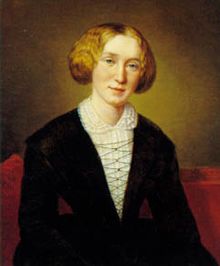
Public domain image of George Eliot, painting by
Alexandre Louis Francois d'Albert Durade
George Eliot (1819-1880)
A selective list of articles for the English Victorian-era novelist George Eliot (Mary Ann Evans), favoring signed articles by recognized scholars and articles published in peer-reviewed sources
Main Page | 19th-Century Literary Criticism | 19th-Century Novelists | 19th-Century Women
Introduction & Biography
Cohen, Paula Marantz. "Why Read George Eliot? Her novels are just modern enough, and just old-fashioned enough, too." American Scholar Spring 2006.
Hughes, Katherine. "The Mystery of Amos Barton." An anonymous short story, submitted by G.H. Lewes, but he was not the author... The Guardian 6 Jan. 2007.
"George Eliot." The Victorian Web. Ed. George P. Landow. Many essays on George Eliot's technique, themes, biography, and the Victorian background.
Stephens, Leslie. George Eliot (1902). A biography of George Eliot by the eminent Victorian Leslie Stephens, father of Virginia Woolf.
Woolf, Virginia. An appreciation of George Eliot. Orig. pub. Times Literary Supplement 1919.
James, Henry. Criticisms and Interpretations, by Henry James. Insightful comments on George Eliot's limitations, from the master writer who admired her greatly. Orig. pub. Atlantic Monthly 1885.
Uglow, Nathan. "George Eliot." Literary Encyclopedia. Eds. Robert Clark, Emory Elliott, Janet Todd. An introduction to George Eliot, from a database that provides signed literary criticism by experts in their field, and is available to individuals for a reasonably-priced subscription. On Adam Bede; on Scenes of Clerical Life; on The Mill on the Floss; on Silas Marner; on Romola; on Felix Holt; on Middlemarch [subscription service].
Hughes, Katherine. A review of George Eliot: The Last Victorian. Also the first chapter of the book. NYTimes, 18 July 1999.
Literary Criticism
Byerly, Alison. "'The Language of the Soul': George Eliot and Music." Nineteenth-Century Fiction 44, 1 (Jun., 1989), pp. 1-17 [free at jstor].
Capuano, Peter J. "An objective aural-relative in Middlemarch." [musical imagery; Arthur Schopenhauer]. SEL: Studies in English Literature 47 (Autumn 2007).
Doody, Margaret Anne. "George Eliot and the Eighteenth-Century Novel." Nineteenth-Century Fiction 35, 3, (Dec. 1980), pp. 260-291 [free at jstor].
Ermarth, Elizabeth Deeds. "George Eliot's Conception of Sympathy." Nineteenth-Century Fiction 40, 1 (Jun., 1985), pp. 23-42 [free at jstor].
Galvan, Jill. "The Narrator as Medium in George Eliot's 'The Lifted Veil.'" Victorian Studies 48, 2 (Winter, 2006), pp. 240-248 [free at jstor].
Graham, Stephen Meyer. "George Eliot's dialogue with history." The interplay of fictional text and historical subtext in Romola, Felix Holt, Middlemarch, and Daniel Deronda. PhD dissertation.
Lesjak, Carolyn. "A modern odyssey: Realism, the masses, and nationalism in George Eliot's Felix Holt." Novel: A Forum on Fiction Fall 1996 [preview or purchase at jstor].
Litvak, Joseph. Caught in the Act: Theatricality in the Nineteenth-Century English Novel. (Univ. of California P 1992). A complete, book-length critical study. Litvak contends that private experience in George Eliot "is a rigorous enactment of a public script that constructs normative gender and class identities." California Digital Library.
Logan, Peter Melville. "George Eliot and the fetish of realism." Studies in the Literary Imagination Fall 2002 [first page only].
Maitzen, Rohan. "George Eliot: The Friendly Face of Unbelief." Whether religious faith is necessary to morality, and how George Eliot answered this question. From Professor Maitzen's blog, 25 June 2007.
Markovits, Stefanie. "George Eliot's Problem with Action." SEL: Studies in English Literature 41 (Autumn 2001) [preview only, muse].
Mitchell, Rebecca N. Learning to Read: Interpersonal Literacy in Adam Bede." Papers on Language and Literature Spring 2008 [subscription service, questia].
Payne, David. "The serialist vanishes: Producing belief in George Eliot." Novel: A Forum on Fiction (Fall 1999) [preview or purchase at jstor].
Price, Leah. George Eliot and the production of consumers." Novel: A Forum on Fiction Winter 1997 [preview or purchase at jstor].
Purdy, Dwight H. "'The One Poor Word' in Middlemarch." [irony, sympathy, treatment of the poor] SEL: Studies in English Literature 44 (Autumn 2004) [abstract only, muse].
Scott, James F. "George Eliot, Positivism, and the Social Vision of Middlemarch." Nineteenth-Century Fiction 16, 1 (Sep., 1972), pp. 59-76 [free at jstor].
Vigderman, Patricia. The traffic in men: female kinship in three novels by George Eliot. Style Spring 1998 [free at jstor].
Watson, Tim. "Jamaica, Genealogy, George Eliot: Inheriting the Empire After Morant Bay." Watson traces changing cultural constructions of race and class in 19th century England through the novelistic career of George Eliot. Jouvert 1.
Witemeyer, Hugh. "George Eliot and Jean-Jacques Rousseau." Comparative Literature Studies 6, 2 (Jun., 1979), pp. 121-130 [free at jstor].
Bibliography & Web Sites
"Women in the Literary Marketplace," an online exhibit from the Division of Rare and Manuscript Collections at Cornell U, contains short entries on several Victorian women authors and their typical themes, information about the publishing context, and some images of first editions.
Web site for Blackwoods Edinburgh Magazine, the influential periodical, edited by "Christopher North," which began publication in 1817 and featured work from such writers as Walter Scott, George Eliot, Anthony Trollope, and Joseph Conrad.
Web site for Tulsa Studies in Women's Literature: A scholarly journal devoted to the study of women's literature of all periods and nationalities [Feminist and Women's Studies].
Web site for Women's Writing, an international scholarly journal focusing on women's writing up to the end of the long nineteenth century. A sample copy is available for viewing, requires registration.
Old reviews from the Atlantic Monthly magazine, a source for literary criticism of George Eliot's novels by her contemporaries. Nineteenth-century editions of the Atlantic Monthly can be searched at this site, provided by Cornell U.
Main Page | 19th-Century Literary Criticism | 19th-Century Novelists | 19th-Century Women
1998-2017 by Jan Pridmore