main page | 20th-century literary criticism | modernist fiction and modernism | about literaryhistory.com
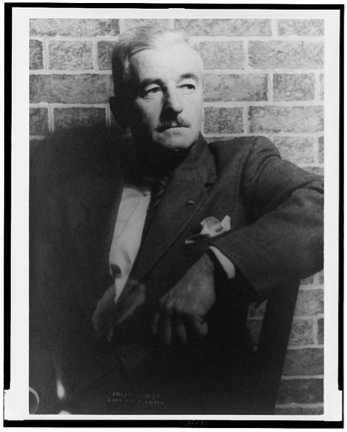
photo of William Faulkner by Carl Van Vechten, public domain photo
William Faulkner (1897-1962)
Literary criticism and analysis for the twentieth-century American novelist and short-story writer William Faulkner. Academic web sites and peer-reviewed journal articles. Links take you directly to articles.
introduction
"William Faulkner." A substantial, short biography of Faulkner; a critical overview briefly summarizes critical approaches to his writing; critical discussions of "Barn Burning" and "A Rose for Emily"; Bibliography; Links. From academic publisher A.B. Longman/Pearson.
"Yoknapatawpha County: William Faulkner on the Web." A trove of information about Faulkner and his novels, including plot summaries, genealogies, character descriptions, and commentary. Web site by Prof. John B. Padgett.
"'What's the Good Word' Radio Program." Wonderful recording of Faulkner answering students' questions about the meaning and intention in his use of dialect in certain passages in his stories and books. Interview. Univ. of Virginia, 1 May 1958.
"University Radio Show." More recording of Faulkner's comments on his use of dialect in his stories and books. Interview [first ten minutes are setup]. Univ. of Virginia, 7 May 1957.
Faulkner's 1949 Nobel Prize for Literature. Nobel Prize web site includes a short biography of Faulkner and his speech.
Kartiganer, Donald. "Remembering Faulkner." Interview with Prof. Kartiganer, a specialist in Faulkner, and with author Lee Smith. Faulkner is discussed as both an innovative modernist and as a southern regionalist who created Yoknapatawpha county. A 1997 PBS program on Faulkner.
Kinney, Arthur F. "Faulkner and Racism." "The single most indelible fact about William Faulkner's work is his persistent concentration on observing and recording the culture and country in which he was born; what is most striking now, as we look back on his legacy from our own, is the enormous courage and cost of that task," says Professor Kinney. Additional commentary on the topic of Faulkner and racism is also available. Connotations 3 (1993-94).
"Faulkner Link to Plantation Diary Discovered." A childhood friend of Faulkner's recalls him reading a slaveholder's diary and ranting about the pro-slavery and pro-Confederacy views it contained: "Faulkner became very angry. He would curse the man and take notes and curse the man and take more notes." NY Times 10 Feb. 2010. For the original interview, see "William Faulkner and the Ledgers of History," by Sally Wolff in The Southern Literary Journal 42, 1 (Fall 2009) pp 1-16.
"Absalom, Absalom!" An electronic chronology of Absalom, Absalom! by professor Stephen Railton at U of Virginia. "Our goal is to take as much advantage as we can of the capacities of electronic technology to help first-time readers orient themselves inside the stories William Faulkner is telling in Absalom, Absalom! while preserving some aspect of the experience of reading it."
Faulkner pronounces "Yoknapatawpha" and explains its meaning in this youtube snippet.
"A Rose for Emily" literary criticism
Curry, Renee R. "Gender and Authorial Limitation in Faulkner's 'A Rose for Emily.'" Mississippi Quarterly 47, 2 (1994) pp 391-402 [questia sub ser].
Heller, Terry. "The Telltale Hair: A Critical Study of William Faulkner's 'A Rose for Emily.'" Prof. Heller discusses the questions critics and readers ask about "A Rose for Emily." Arizona Quarterly 28 (1972).
Nebeker, Helen E. "Emily's Rose of Love: Thematic Implications of Point of View in Faulkner's 'A Rose for Emily.'" Bulletin of the Rocky Mountain MLA 24, 1 (March 1970) pp 3-13 [free at jstor, click "Preview" or "Read Online"].
O'Bryan-Knight, Jean. "From Spinster to Eunuch: William Faulkner's 'A Rose for Emily' and Mario Vargas Llosa's Los cachorros." Comparative Literature Studies 34, 4 (1997) pp 328-347 [free at jstor, click "Preview" or "Read Online"].
Skinner, John L. "'A Rose for Emily': Against Interpretation." The Journal of Narrative Technique 15, 1 (Winter 1985) pp 42-51 [free at jstor, click "Preview" or "Read Online"].
Stone, Edward. "Usher, Poquelin, and Miss Emily: The Progress of Southern Gothic." Georgia Review 14, 4 (Winter 1960) pp 433-43 [free at jstor, click "Preview" or "Read Online"].
Stronks, James. "A Poe Source for Faulkner? 'To Helen' and 'A Rose for Emily'" [and Edgar Allan Poe]. Poe Newsletter 1, 1 (1968).
Sullivan, Ruth. "The Narrator in 'A Rose for Emily.'" Journal of Narrative Technique 1, 3 (Sept. 1971) pp 159-178 [free at jstor, click "Preview" or "Read Online"].
Watkins, Floyd C. "The Structure of 'A Rose for Emily.'" Modern Language Notes 69, 7 (Nov. 1954) pp 508-10 [free at jstor, click "Preview" or "Read Online"].
Faulkner's other works
Altman, Meryl. "The Bug That Dare Not Speak Its Name: Sex, Art, Faulkner's Worst Novel, and the Critics" [on Faulkner's novel Mosquitoes]. Prize-winning critical article at the Faulkner Journal.
Dimino, Andrea. "Why Did the Snopeses Name Their Son 'Wallstreet Panic'? Depression Humor in Faulkner's The Hamlet." Studies in American Humor [gone].
Dussere, Erik. "The Debts of History: Southern Honor, Affirmative Action, and Faulkner's Intruder in the Dust." Faulkner Journal 17, 1 (2001). Prize-winning critical article at the Journal.
Folks, Jeffrey J. "Crowd and Self: William Faulkner's Sources of Agency in The Sound and the Fury." On the circumstances under which The Sound and the Fury was written. The Southern Literary Journal 34, 2 (Spring 2002) pp 30-44 [substantial extract, muse].
Harrison, Suzan. "Repudiating Faulkner: Race and Responsibility in Ellen Douglas's The Rock Cried Out." Harrison argues that Ellen Douglas reconsiders many issues central to the Southern Renascence, as that movement has been critically defined: "Explicitly engaging the shadow of Faulkner Douglas's novel [The Rock Cried Out raises questions about how the white southern writer confronts issues of race and guilt in a post-renascence, post-Civil Rights era South." The Southern Literary Journal 36, 1 (Fall 2003] pp. 1-20 [free at jstor, click "Preview" or "Read Online"].
Heller, Terry. "Intruders in the Dust: The Representation of Racial Problems in Faulkner's Novel and in the MGM Film Adaptation." Coe Review 8 (1977) pp 79-90.
Kartiganer, Donald M. "'So I, Who Had Never Had A War...': William Faulkner, War, and the Modern Imagination." MFS Modern Fiction Studies 44, 3 (Fall 1998) pp 619-45 [substantial extract, muse].
★Kartiganer, Donald M. "The Sound and the Fury and Faulkner's Quest for Form." ELH 37, 4 (Dec. 1970] pp 613-639 [free at jstor, click "Preview" or "Read Online"].
Llewellyn, Dara. "Waves of time in Faulkner's Go Down, Moses." Llewellyn notes that "readers of William Faulkner must sort through complex chronological developments when reading his stories." Studies in Short Fiction 33, 4 (Fall 1996) [questia sub ser].
Martin, Reginald. "Faulkner's Southern reflections: the black on the back of the mirror in 'Ad Astra.'" Says Martin, "William Faulkner's black characters are considered the strongest characters in his narratives." African American Review Spring 1993 [questia sub ser].
Peek, Charles A. "That Evening Sun(g): Blues Inscribing Black Space in White Stories." Southern Quarterly Spring 2004 [questia sub ser].
Sassoubre, Ticien Marie. "Avoiding Adjudication in William Faulkner's Go Down, Moses and Intruder in the Dust." Criticism 49, 2 (Spring 2007) pp 183-214 [substantial extract, muse].
Shiffman, Smadar. "Romantic, radical, and ridiculous: Faulkner's hero as an oxymoron." Style 29, 1 (Spring 1995 [questia sub ser].
Singal, Daniel J. Excerpt from William Faulkner: The Making of a Modernist (U of North Carolina P 1997).
Wainwright, Michael. "Coordination Problems in the Work of William Faulkner." Papers on Language and Literature, Winter 2007 [questia sub ser].
Zeitlin, Michael. "The uncanny and the opaque in Yoknapatawpha and beyond." Mississippi Quarterly 57, 4 (Fall 2004) [questia sub ser].
teaching guides
A Teacher's Guide to William Faulkner, ed. John Lowe. Lowe begins with an acknowledgment of the difficulties students have with Faulkner. He recommends approaching Faulkner as an interpreter of history--in the sense of the history of modernism, and of southern and American history--and exploring his portrayals of sex, social class, and especially race. From textbook publisher Heath.
Teaching Faulkner Newsletter. Many articles useful for teachers are available at the Teaching Faulkner Newsletter. [Links we formerly included will not function now, since the urls of the articles have all changed, but researchers can find articles by searching from the newsletter's main page.]
main page | 20th-century literary criticism | modernist fiction and modernism | about literaryhistory.com
1998-2014 by LiteraryHistory.com